Did the universe have a beginning, did it form from something else, or has it always existed?
Currently, the question remains whether the universe has always been and will always be, or if it could eventually come to an end.
Is the extent of its boundaries truly infinite, as most of us think?
An infinite, eternally existing universe would have no beginning and could have no end, but if it is finite, then it must have originated at some point in time and space.
From the moment we understood the fundamental workings of the universe, we have taken the gravitational factor into account and have continued to do so. If the universe were finite, then at a certain moment, the gravitational force could pull all the matter in the universe towards the center, destroying itself. If it is infinite, then there is no center to which gravity could pull, as there would be infinite forces acting in every direction, balancing each other in an eternally stable system.
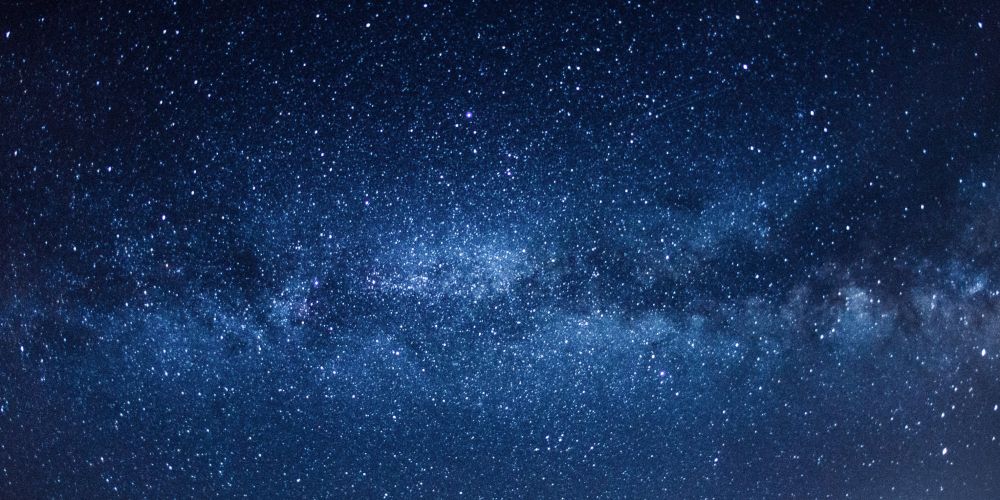
Using logical reasoning, according to the Olbers' paradox (a physical paradox formulated by the German astronomer Heinrich Wilhelm Olbers), if the universe is infinite, then due to the accumulation of light from an infinite number of stars, the night sky should be bright everywhere. Wherever we look in the night sky, our gaze would fall upon the surface of a star, resulting in daylight brightness even at night. However, this is not what we experience, so according to this, there cannot be an infinite number of stars out there, meaning the universe is finite.
Of course, the paradox can be refuted with scientific arguments, and it can be debated. The universe is not completely transparent, and the light from distant stars is dimmed by dust, gases, and darker celestial bodies, which is why their light does not reach us from great distances. In reality, this does not solve the paradox, as according to the first law of thermodynamics, energy must be conserved, meaning the intervening material must heat up and thus must emit light. This would again result in uniform radiation in all directions. It is a thought-provoking theory, but we still cannot determine based on this whether the universe is finite or infinite. We cannot be sure of the answer.
The universe is currently expanding at an accelerating rate, and distant stars are moving further away from us. The universe is expanding all around us, but the expansion is on such a large scale that we do not experience it here on Earth. Every point in the universe is moving away from the others as time passes. It is not that stars or galaxies are getting larger, but rather the space between individual objects is what is expanding. How do we know this?
The expansion of the universe was discovered by astronomer Edwin Hubble in 1929, combining the work of many scientists. In 1915, Albert Einstein formulated the general theory of relativity, which described the workings of gravity. When Einstein applied the theory to the entire universe, he reached a peculiar conclusion that the universe must be dynamic, either contracting or expanding. Einstein did not believe his own results, assuming that the size of the universe did not change. Meanwhile, another astronomer, Vesto Slipher, was working on a detailed mapping of the night sky. He examined numerous objects he saw in his telescope. He measured the spectrum of nebulae, the amount of light they emitted at different wavelengths. He recognized that almost all of their light was shifted towards the red, their light was redder than it should have been. Slipher knew that if an object's light is redshifted, it is moving away from the Earth, and that the object's speed is proportional to the redshift. He calculated the speeds of the nebulae and found that they were moving away from us at incredible speeds. For example, the Sombrero Nebula is moving away at over 4 million km/h! This leads to the resolution of the previously mentioned Olbers' paradox! Scientists have already proven that by tracing the process backward in time, our universe must have been smaller and smaller in the past until we reach the moment when everything began. This line of reasoning leads us to the theory of the Big Bang. The darkness of the night sky also supports the Big Bang theory, as it suggests that the universe only existed for a finite time in the past, allowing only a finite number of stars' light to reach us.
Space was smaller in the past and could have originated at an initial moment. As a result of Albert Einstein's work, we know that space and time cannot be separated; that is, if space originated at the initial moment, then time must have originated with it, leading to the creation of spacetime in which we all exist.
It is conceivable that the universe is finite, yet still infinite! In the case of an expanding universe, the question immediately arises: how long will this expansion continue? Could it ever come to an end? The question is whether there is enough gravitational influence from all the matter found in the universe to reverse the expansion and pull everything back to an initial point.
A pulsating universe has emerged in the minds of scientists, which is born, expands, then the expansion slows down until it eventually stops, transitions into contraction, and then perishes, starting the process all over again. In this world model, the universe is finite, as it begins with the Big Bang and ends with collapse, yet it would still be infinite, as it pulsates in the cycle of existence and destruction for eternity.
At the same time, a strange pattern has been identified in the cosmic microwave background radiation, which may have remained from a previous universe.
Research suggests that the amount of observable matter in the universe is very little for gravitational collapse, and it has also been proven that the universe is expanding at an accelerating rate. We cannot describe this behavior with our currently known theories at all. Thus, the question posed in the title, along with many others, remains unanswered for now.
Source:
Origo.hu
Wikipedia





Comments